When To Buy Call Options vs Put Options: Complete Decision Framework for 2026
The decision between buying call options vs put options requires systematic analysis of four critical factors:
- overall market environment,
- directional bias confirmation,
- individual stock structure,
- and entry timing validation
Rather than guessing market direction, successful options traders use GammaEdge’s systematic framework to assess market conditions, identify structurally aligned stocks, and time entries when multiple indicators confirm the same directional thesis.
You’re staring at your watchlist after market close.
AAPL looks technically strong with a perfect cup-and-handle pattern, but the broader market feels shaky with selling pressure building.
TSLA has a clear breakdown below key support, but you’re not sure if puts are the right play or where to target.
Sound familiar?
Table of Contents
The Dilemma Every Options Trader Faces When Deciding on Call Options vs Put Options
Most traders encounter this exact scenario daily – individual stocks showing compelling setups that contradict broader market conditions.
You know the basics:
- (Long) Calls profit from upward moves
- (Long) Puts profit from downward moves
But how do you systematically decide which direction has the highest probability of success?
What Usually Happens
Here’s the typical process:
- You pick the direction based on the most obvious signal (usually the individual stock pattern)
- Buy your options
- Hope everything works out
Sometimes it does. Sometimes the broader market overwhelms your perfectly analyzed stock setup, and you watch your calls get crushed despite being “right” about the company.
The Reality Most Traders Miss
Your AAPL calls don’t just compete against AAPL’s fundamentals and technicals – they’re fighting against the entire market’s structural forces.
When the broader market environment favors downward pressure, even the strongest individual stocks struggle to maintain sustained upward moves.
Conversely, when market structure supports upward momentum, even mediocre stocks can deliver explosive call option gains.
Where Most Options Education Fails
You learn what calls and puts are. You understand basic mechanics like time decay and implied volatility.
But you’re never taught how to systematically assess whether market conditions actually support your directional choice.
What You’ll Unlock Today
By the end of this article, you’ll have a complete framework that removes guesswork from the most critical decision in options trading:
- Determining when market conditions favor calls versus puts
- Finding specific stocks where those conditions create the highest probability of success
- Timing your entries when multiple indicators align
Let’s dive in.
The Call Options vs Put Options Direction Problem Most Traders Face
Here’s what happened with those TSLA puts you bought last week: The stock had a perfect technical breakdown, RSI was moving lower, and the chart looked textbook bearish. You bought puts expecting easy profits.
Instead, TSLA bounced 8% the next day while your puts lost 40% of their value.
What went wrong?
The Traditional Approach Falls Short
Most traders pick call and put options using this flawed process:
Step 1: Focus on Individual Stock Analysis
- Look at chart patterns and technical indicators
- Analyze company-specific news or earnings
- Make directional decisions based on single stock factors
Step 2: Choose Strikes Based on Price
- Pick what you can afford
- Target arbitrary percentage moves
- Hope the direction works out
Step 3: Time Entries on Chart Patterns
- Enter on breakouts or breakdowns
- Ignore broader market context
- Cross fingers and hope for the best
This approach ignores the most critical factor in options success: the broader market environment that determines whether your individual stock analysis actually matters.
Why Even “Perfect” Stock Analysis Fails
Here’s the truth most traders learn the hard way:
Individual stocks don’t trade in isolation. They’re influenced by massive structural forces that can overwhelm even the most compelling single-stock setups.
Consider this scenario:
- Your technical analysis on TSLA is perfect
- The breakdown pattern is textbook
- You buy puts expecting a 10% decline
But if the broader market is in a structurally bullish environment – with call speculation in the overall options market building, institutional money flowing into equities, and momentum building across multiple timeframes – your individual stock analysis becomes irrelevant.
The market’s structural forces will likely carry TSLA higher despite its technical weakness.
The Hidden Cost of Fighting Market Structure
When you trade options without considering market environment:
- Success becomes random – Sometimes your analysis works, sometimes it doesn’t, with no clear pattern of why
- Risk management breaks down – You can’t properly size positions because you don’t understand the underlying probability structure
- Timing becomes impossible – Without market context, every entry feels like a guess
- Confidence erodes – String together a few losses on “perfect” setups, and you start second-guessing everything
The GammaEdge Solution: Systematic Environment Assessment To Buying Call Options vs Put Options
Instead of gambling on individual stock moves, successful options traders use a systematic approach:
Step 1: Assess the overall market environment first
- Is the structural backdrop bullish or bearish?
- What forces are driving market momentum?
- Are conditions favorable for directional trades?
GammaEdge’s Solve: We’ve developed the Market Trend Model (based off the Tick Index), tracks momentum under the hood of the market across multiple time frames. Additionally, we analyze the SPX options market structure to get an in-depth understanding of if call or put speculators are in control. By combining these two methodologies, it provides us with a clear picture of the strength or weakness in the market overall.
Step 2: Align your directional bias with market structure
- If market environment is bullish → Focus only on call opportunities
- If market environment is bearish → Focus only on put opportunities
- If market environment is choppy → Avoid directional trades entirely
Step 3: Use data-driven scans to find structurally aligned stocks
- Rather than screening random stocks, identify those where options positioning supports your market bias
- Focus on stocks where smart money is already positioned in your direction
GammaEdge’s Solve: We’ve developed proprietary scans that incorporate the options market to help us identify those stocks which support our directional thesis. So if you’re bullish, we have scans that look for call-dominated stocks. And if you’re bearish, then we have scans that look for put-dominated stocks.
Step 4: Time entries using structural validation
- Enter when stocks break through key structural levels that confirm your thesis
- Avoid the guesswork of arbitrary chart levels
GammaEdge’s Solve: We’ve developed critical levels based on our analysis of options market structure and how speculators are positioned. These levels include our transition zones, which help us identify where choppy price action is likely to occur as well as where we should be getting long or short based on a breakout (or breakdown) through that zone. From there, we look to see where upside and downside speculator positioning is concentrated for key upside/downside profit target levels.
This systematic approach transforms options trading from speculation into strategic positioning with market forces working in your favor rather than against you.
The Four-Step GammaEdge Framework for Call Options vs Put Options
Most traders approach options direction like this: “This stock looks bullish, so I’ll buy calls.” Or “Bad earnings are coming, so I’ll buy puts.”
That’s backwards.
The GammaEdge Framework starts with the big picture and narrows down to specific opportunities. Instead of hoping your individual stock analysis overcomes hostile market conditions, you align your trades with the dominant structural forces from day one.
Here’s our complete systematic framework:
The Four-Step Process
Step 1: Assess Overall Market Environment
- Use the Market Trend Model to understand momentum across multiple timeframes
- Analyze SPX options structure to determine if call (bulls) or put (bears) speculators control the structure
- Classify the current environment as bullish, bearish, or choppy
Step 2: Determine Your Directional Bias
- If market environment = bullish → Focus exclusively on call opportunities
- If market environment = bearish → Focus exclusively on put opportunities
- If market environment = choppy → Avoid directional trades entirely
Step 3: Identify Structurally Aligned Stocks
- Use GammaEdge’s proprietary scans to find stocks where options positioning supports your bias
- Filter for stocks where smart money is already positioned in your direction
- Focus your analysis only on structurally favorable candidates
Step 4: Validate Entry Timing
- Confirm stocks are trading above transition zones (for calls) or below transition zones (for puts)
- Time entries when structural levels confirm your directional thesis
- Set profit targets based on actual options positioning, not arbitrary technical levels (ideally, you’ll see confluence between the two approaches)
Why This Framework Works
The key insight is that you’re not fighting against market structure – you’re positioning when multiple layers of analysis confirm the same directional bias.
- Traditional Approach: Pick direction → Hope market cooperates → Often fail
- GammaEdge Framework: Understand market → Align with dominant forces → Systematically succeed
Step 1: Assess Overall Market Environment When Choosing Call Options vs Put Options
Before making any directional decisions, you need to understand what the broader market is actually doing. Not what the headlines say. Not what the talking heads predict. But rather, what the actual money flows and positioning data reveal about market structure.
GammaEdge’s Market Trend Model Analysis
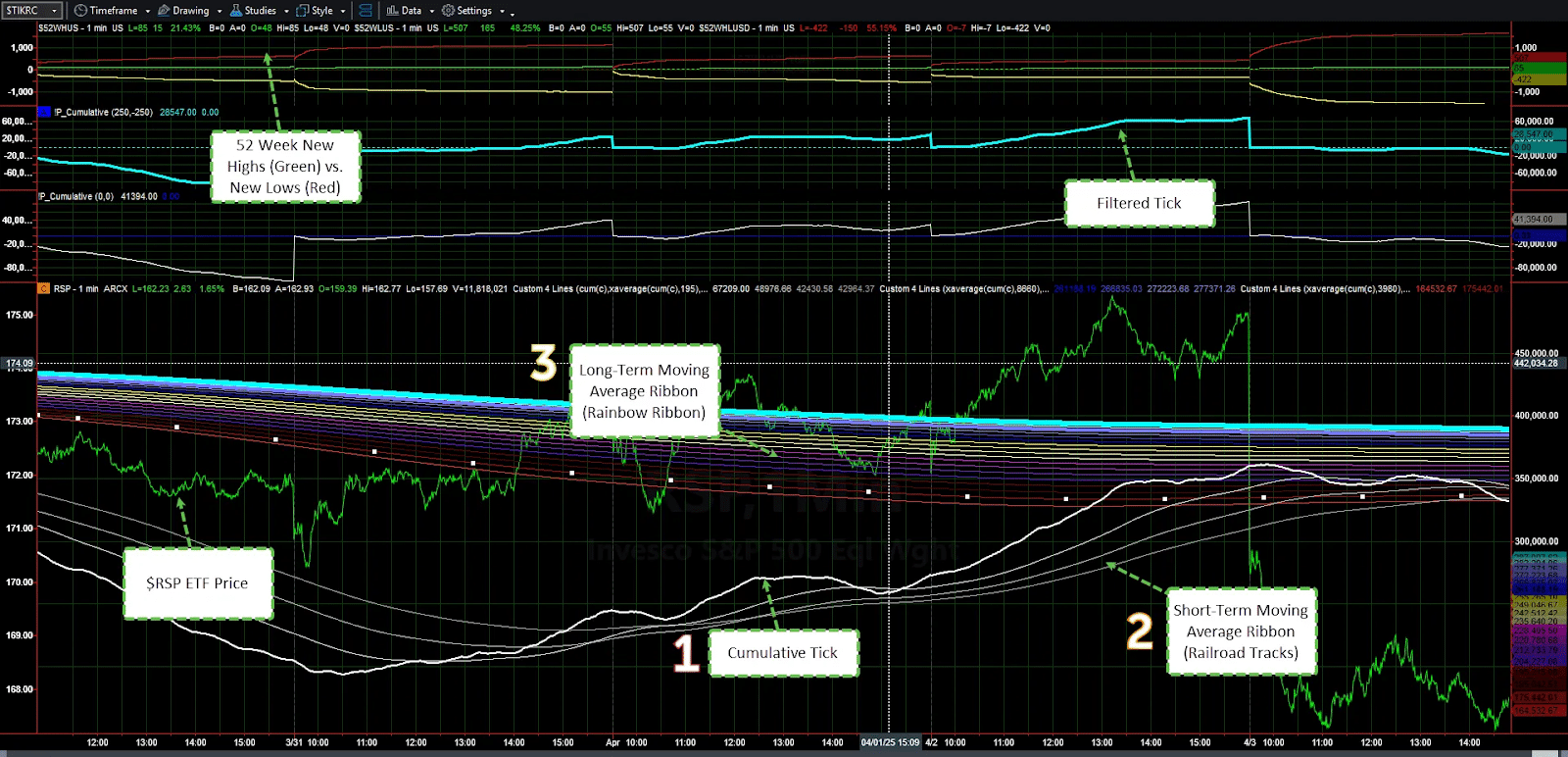
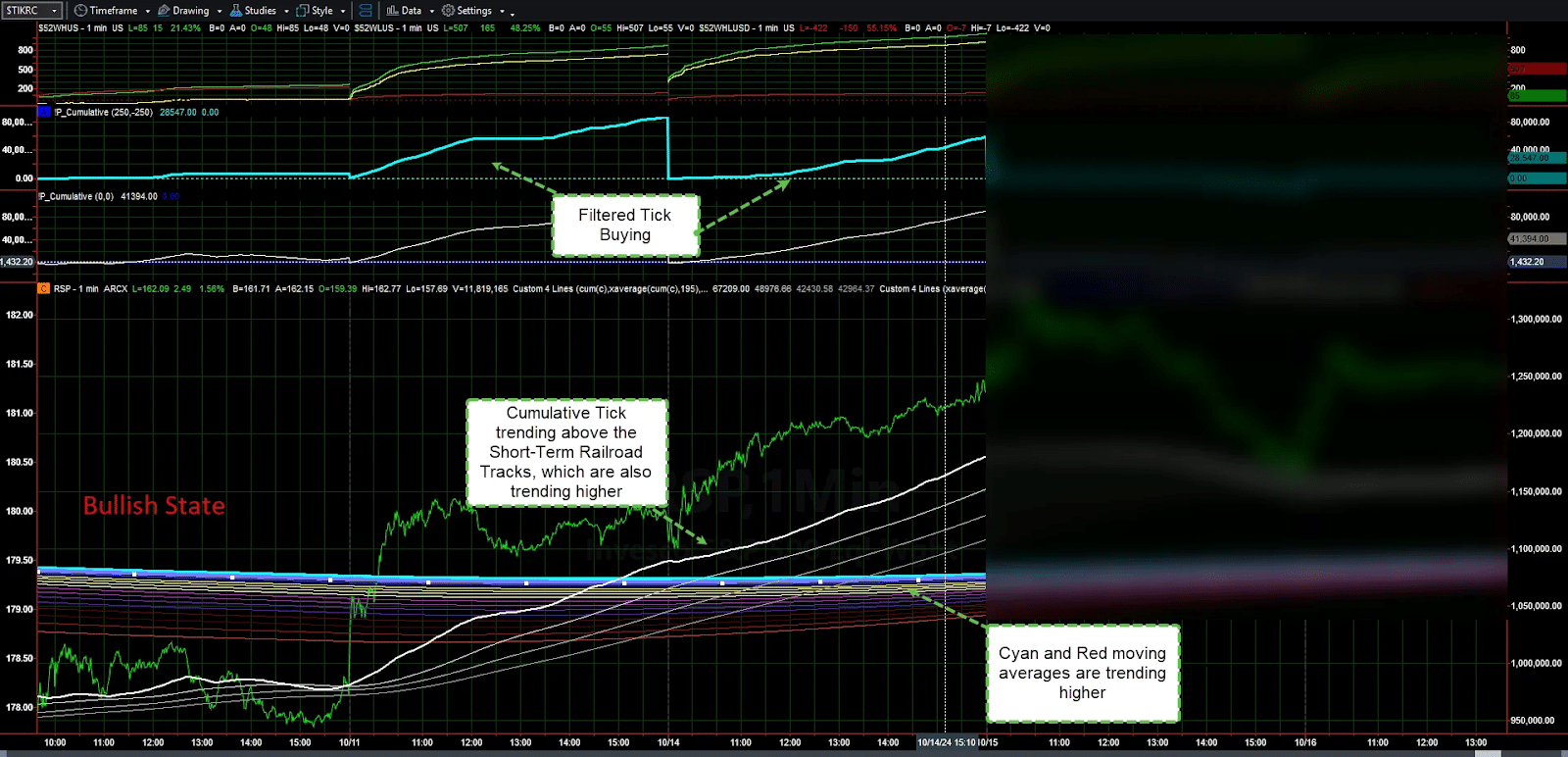
The Market Trend Model gives you real-time insight into buying and selling pressure across multiple timeframes. Think of it as your market momentum dashboard.
What to Look For:
(1) Cumulative Tick (Real-Time Momentum)
- Trending higher = Active buying pressure supporting call strategies
- Trending lower = Active selling pressure supporting put strategies
- Flat or choppy = Mixed signals, avoid directional trades
*Timeframe: Intraday
(2) Railroad Tracks (Short-Term Trend)
- Properly stacked and trending higher = bullish momentum
- Rolling over and trending lower = bearish momentum
- Mixed or intertwined = Uncertain short-term direction
Timeframe: 1-3 days
(3) Rainbow Ribbon (Longer-Term Context)
- Red moving average above cyan = Longer-term uptrend intact
- Red moving average below cyan = Longer-term downtrend active
- Converging averages = Potential trend change developing
Timeframe: 1-3 weeks
Filtered Tick (Institutional Participation)
- Large buying transactions (+1,000 ticks) = Professional money supporting the move
- Large selling transactions (-1,000 ticks) = Professional money driving decline
- Minimal activity = Be cautious, no real commitment in either direction.
*Timeframe: Intraday
And so you have it for your reference, here is an example of a Market Trend Model that is bullish in nature:
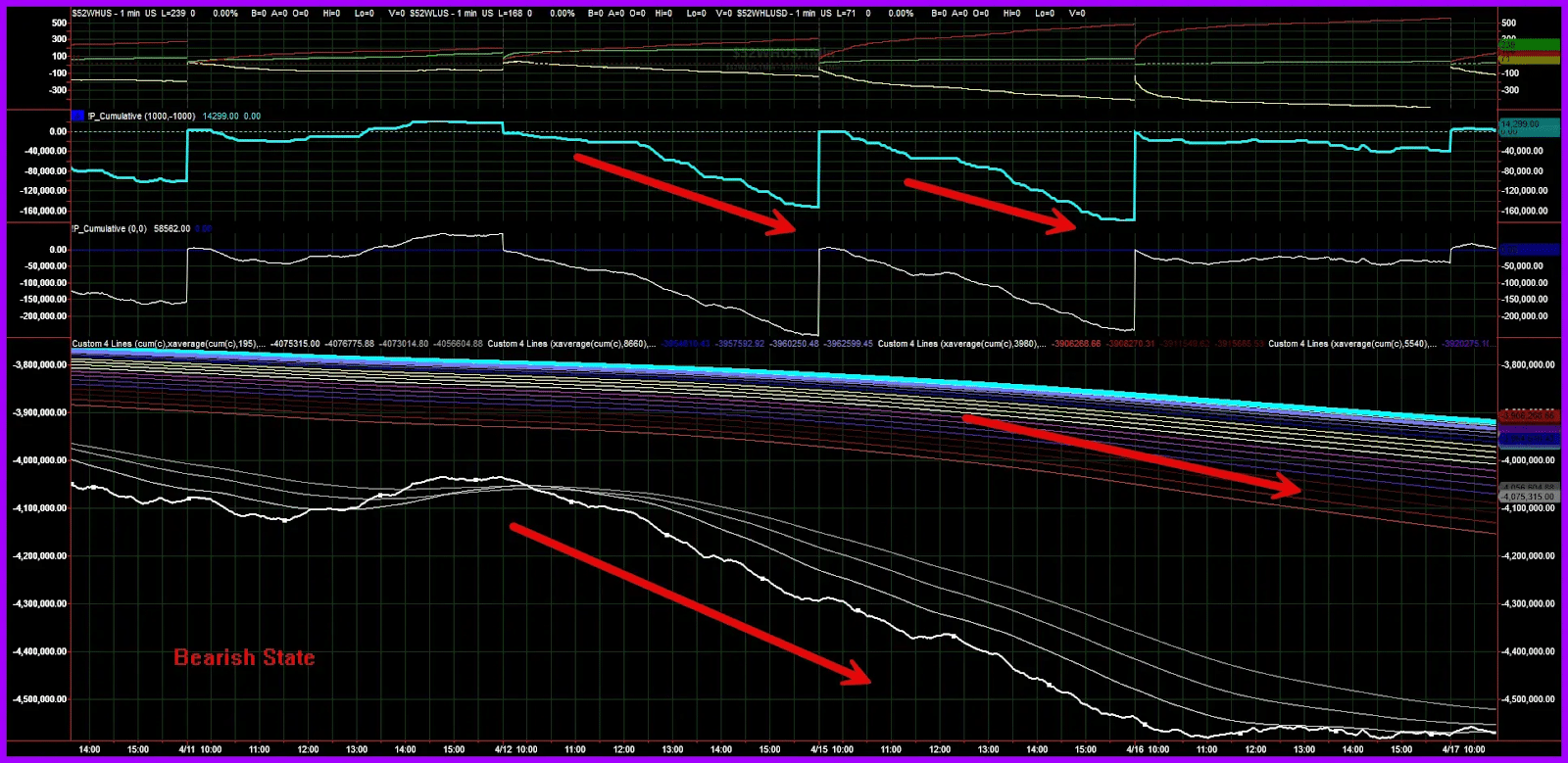
And here is another example of one that is bearish in nature. The stark difference in the direction of momentum should jump off the page at you!
Further — this direction should mean one thing when buying call options vs put options:
You always want to be on the side of the market’s trend!
SPX Full Complex Structure Analysis
While the Market Trend Model shows you momentum when determining call options vs put options, SPX structure analysis reveals who’s actually in control – call speculators (bulls) or put speculators (bears).
GammaEdge Solution: Visual Market Structure
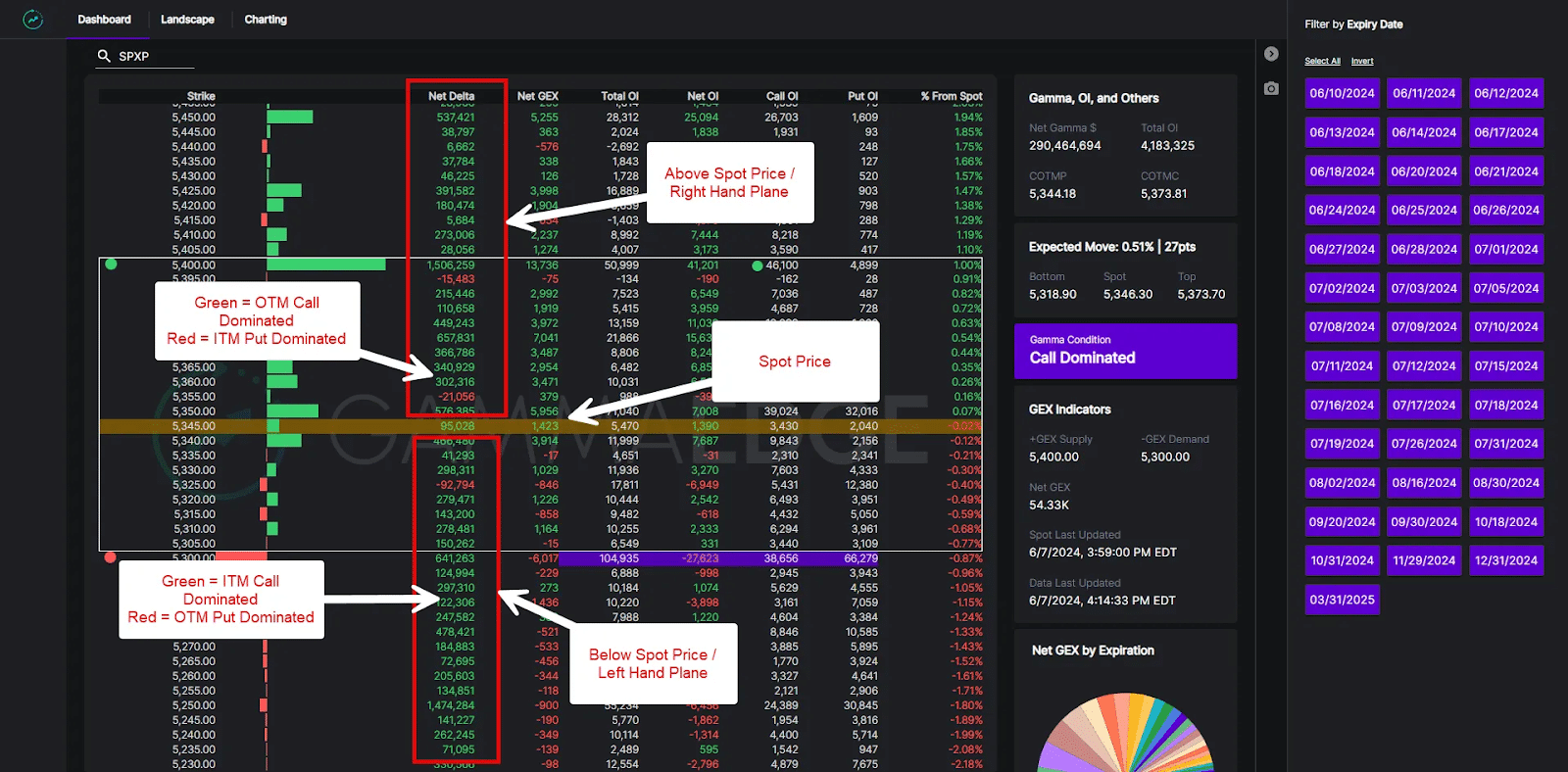
Using our Web App Dashboard, you can instantly see:
Call vs Put Dominance
- Green strikes (call-dominated) above and below spot price = Bullish structure
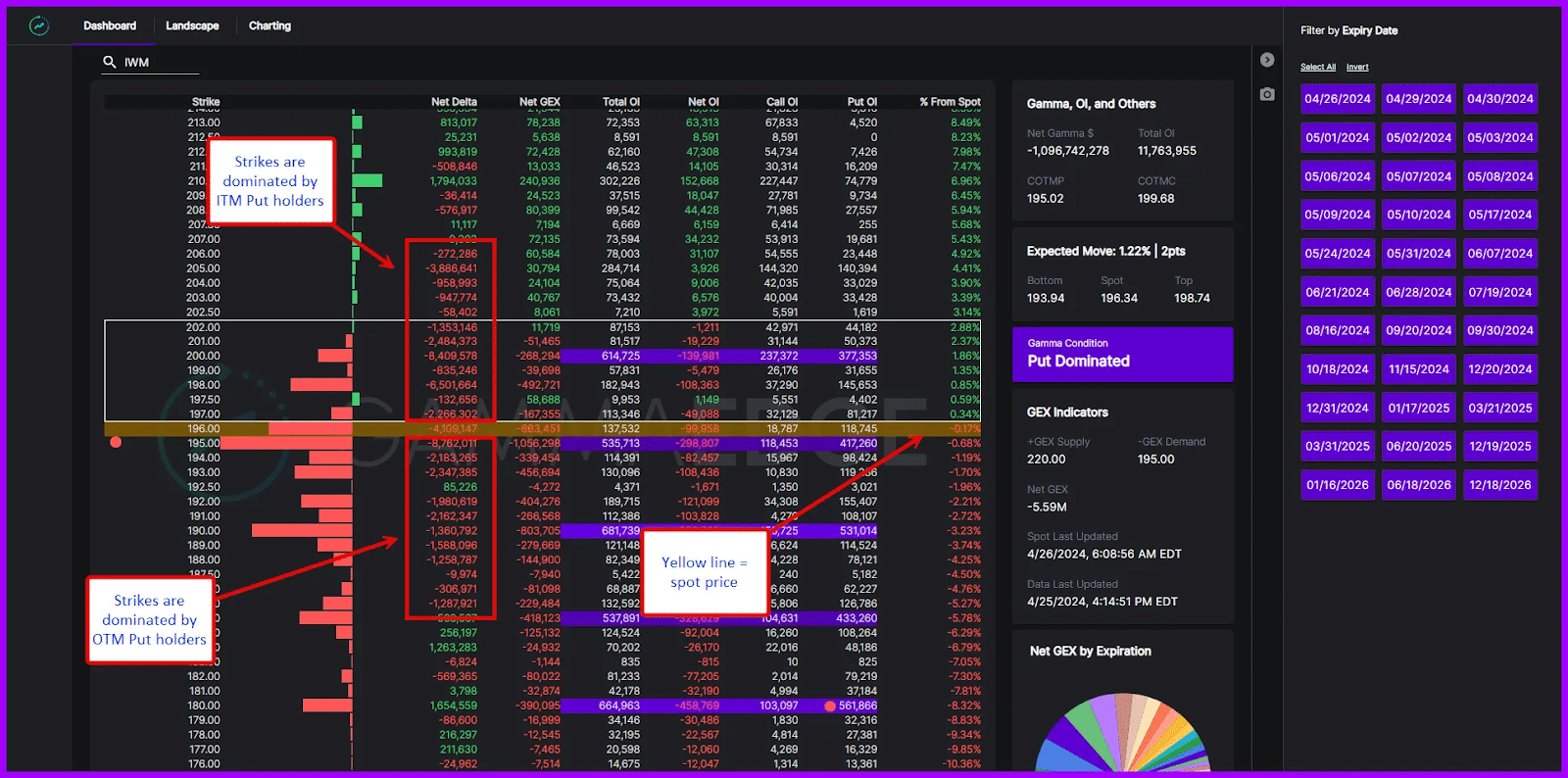
- Red strikes (put-dominated) above and below spot price = Bearish structure
- Mixed colors = Uncertain structure, proceed with caution
And so you have it for your reference and knowledge, the above dashboard visual shows us the structure is “green”, which indicates to us that there is a call-dominated environment. This is likely when you’ll want to be buying call options vs put options.
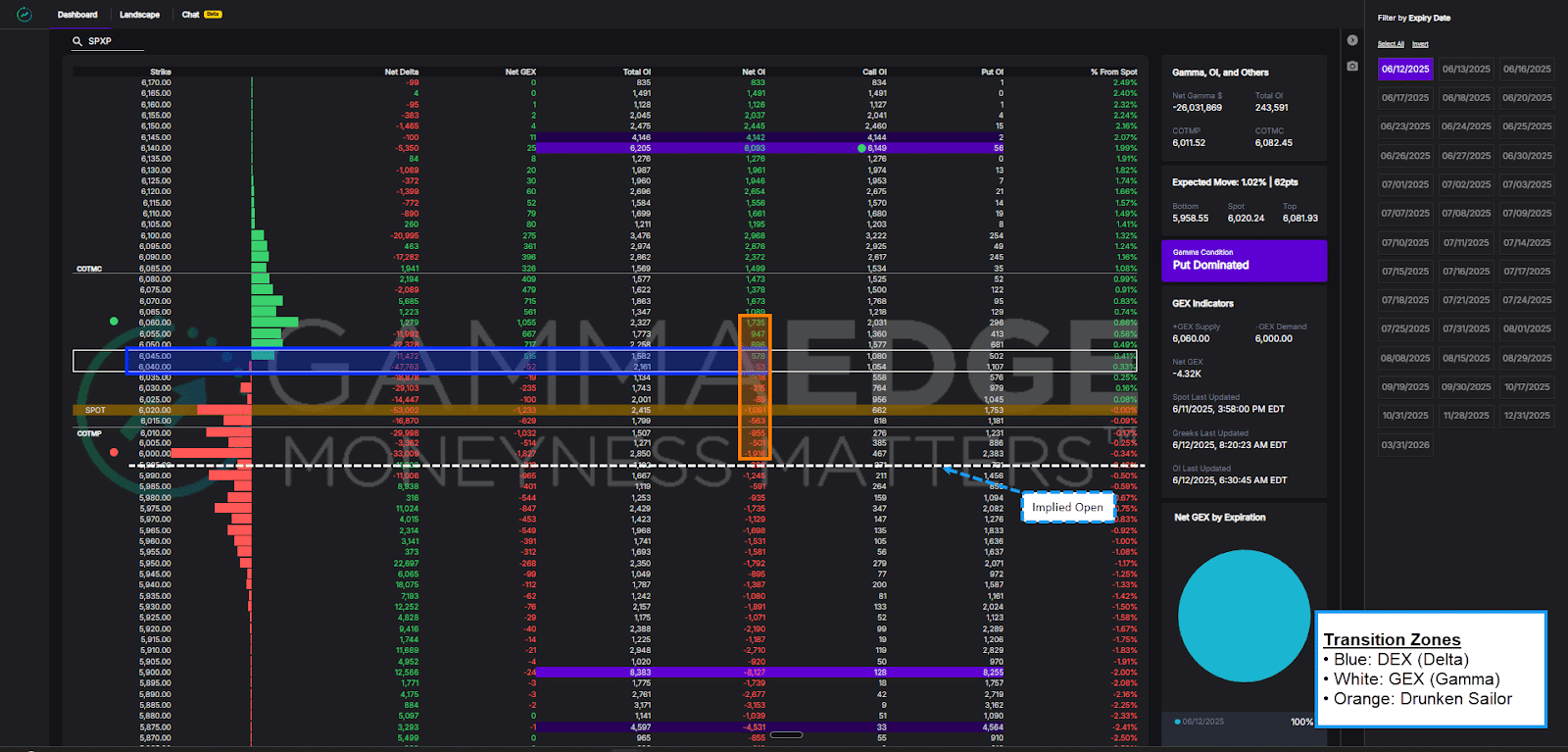
Now compare that to the structure below which is red, which indicates a put-dominated environment. This is likely when you’ll be buying put options vs call options.
That’s the beauty of our dashboard, it quickly allows us to visualize the options market positioning for any underlying.
Transition Zone Analysis
- SPX trading above transition zones = Bullish momentum likely to continue
- SPX trading below transition zones = Bearish momentum likely to continue
- SPX trapped within transition zones = Range-bound conditions, avoid directional trades
The GammaEdge transition zones are critical to our trading framework. There are three key transition zones we have developed which are built off of Gamma, Delta, and the distribution of speculation (aka Drunken Sailor Range), These zones were designed show us the areas of congestion in the structure as well as the areas where price should see a continuation move higher or lower, depending on which side of the transition zone is breached.
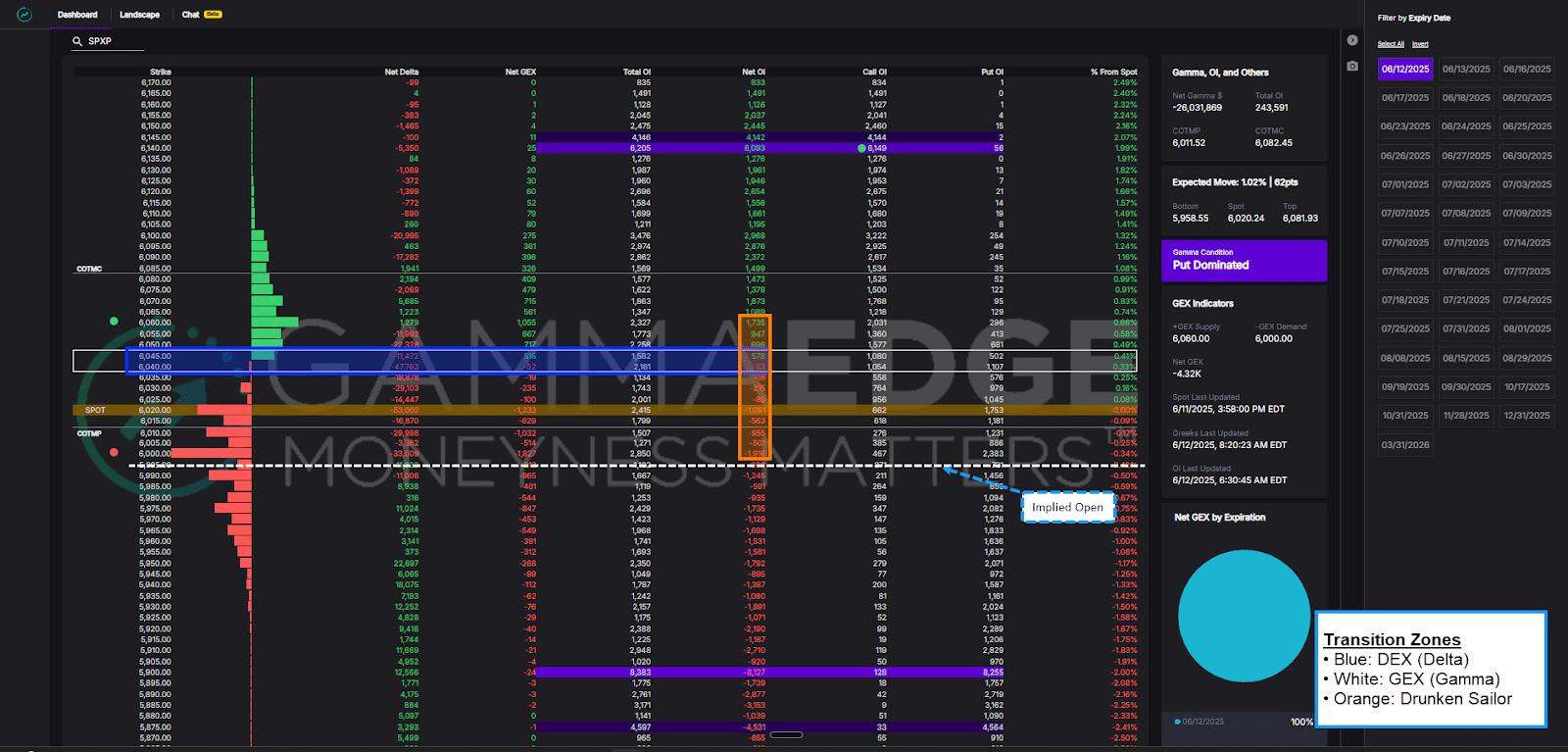
Key Structural Levels
- +GEX and COI levels show where call speculation is concentrated (upside targets)
- -GEX and POI levels show where put speculation is concentrated (downside targets)
The beauty of our systematic process to buying call options vs put options is there is no subjectivity to it. We utilize the options market structure to understand what strikes key speculators have targeted. This then helps to inform us as to the short-term potential for an upside move (above the transition zone) or downside move (below the transition zone) the trade may have.
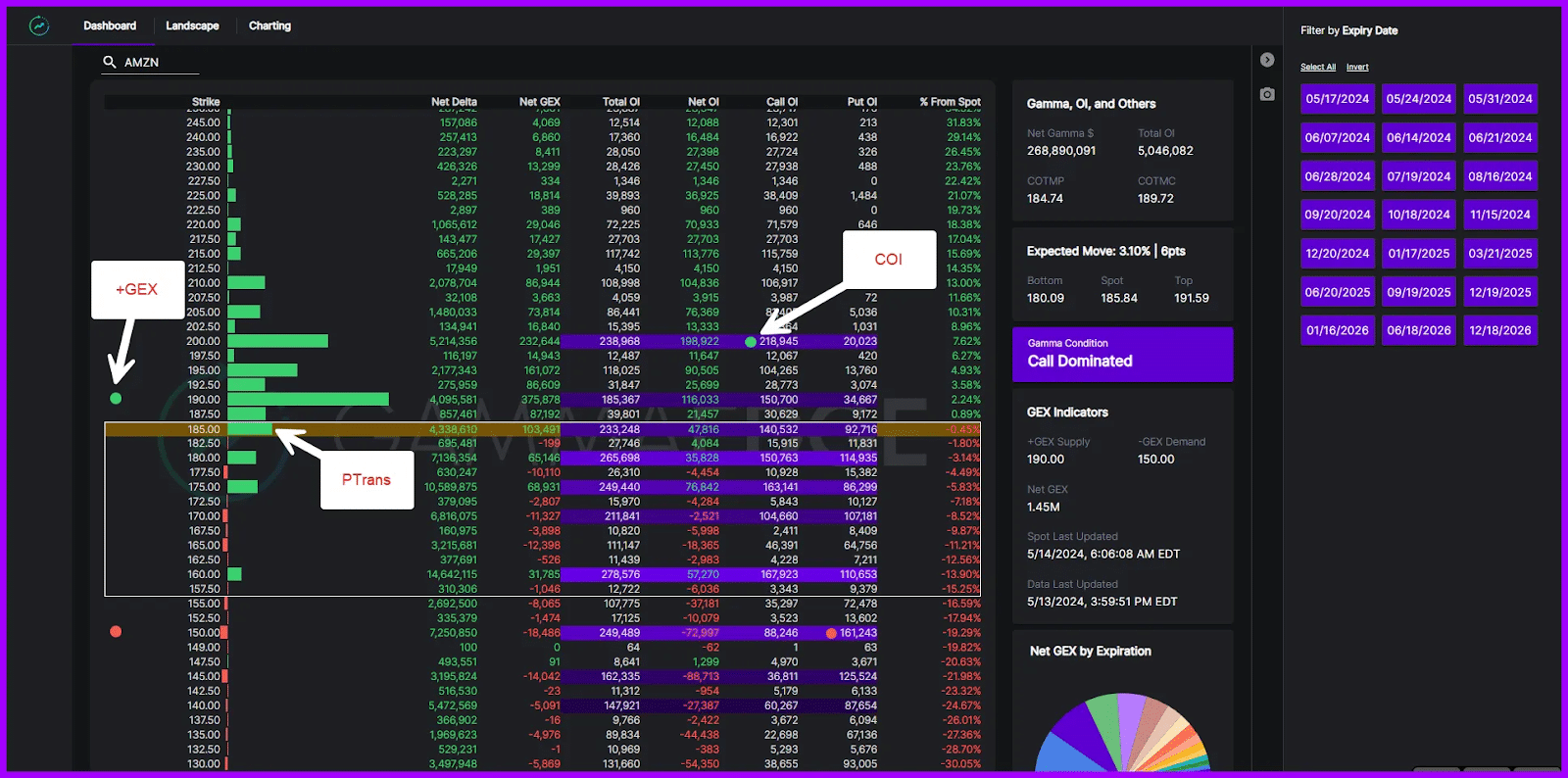
Market Environment Classification
Based on your analysis, classify the current market environment when determining call options vs put options:
Bullish Environment (Focus on Calls)
- Market Trend Model showing sustained buying pressure
- SPX structure dominated by call positioning above and below current price
- Price trading above key transition zones
- Institutional participation supporting upward moves
Bearish Environment (Focus on Puts)
- Market Trend Model showing sustained selling pressure
- SPX structure dominated by put positioning above and below current price
- Price trading below key transition zones
- Institutional participation driving declines
Choppy Environment (Avoid Directional Trades)
- Mixed signals from Market Trend Model
- Uncertain SPX structure with competing forces
- Price trapped within transition zones
- Minimal institutional participation or conflicting signals
The Critical Rule: Never fight the market environment. If your analysis shows bearish conditions, don’t look for call opportunities hoping to catch a reversal. Focus exclusively on the direction that market structure supports.
Once you’ve classified the market environment using these systematic criteria, determining your directional bias becomes straightforward.
Step 2 – Determine Your Directional Bias
Once you’ve assessed the market environment, determining your directional bias to call options vs put options becomes straightforward. This isn’t about abandoning your existing analysis – it’s about enhancing it with structural intelligence that dramatically improves your probability of success.
GammaEdge Advantage: Systematic Bias Assignment
Rather than making directional decisions based on individual stock analysis alone, you now align your trades with the dominant market forces that can either amplify or undermine your positions.
When Market Environment = Bullish
Focus exclusively on call options vs put options during this session. Your existing technical analysis, fundamental research, or momentum strategies become significantly more powerful when aligned with supportive market structure.
Here’s what this means practically:
- That AAPL breakout pattern you identified has structural tailwinds behind it
- Your momentum scanner results get filtered for only the most promising long candidates
- Your risk/reward calculations improve because market forces support your directional bias
When Market Environment = Bearish
Focus exclusively on put option opportunities during this session. Your bearish analysis – whether technical breakdowns, fundamental concerns, or short-selling signals – gains structural support from the broader market environment.
Practical implementation:
- Those breakdown patterns in your watchlist now have institutional selling pressure behind them
- Your short candidate screens become more selective and higher probability
- Put option strategies align with market maker hedging that can accelerate your positions
When Market Environment = Choppy This is when discretion becomes the better part of valor. Choppy environments can turn even the best individual stock analysis into coin flips, regardless of your analytical approach. This is key to understand — not every environment is healthy for call options vs put options buying.
During these periods:
- Consider reducing position sizes across all strategies
- Focus on higher-conviction setups only
- Wait for clearer structural signals before committing significant capital
Why This Enhances Rather Than Replaces Your Analysis
The key insight: Market environment analysis doesn’t tell you which specific stocks to trade – it tells you which direction has the highest probability of success when buying call options vs put options, allowing you to focus your existing analytical skills where they’re most likely to work.
If you’re a technical analyst, you still use your patterns and indicators. But now you know whether to look for bullish or bearish setups based on what market structure supports.
If you use momentum strategies, you still identify stocks with strong price action. But you filter for momentum in the direction that market forces support.
Avoiding the Directional Call Options vs Put Options Trap
Here’s where many traders go wrong: They identify a compelling individual setup that contradicts the market environment and convince themselves “this time is different.”
Example scenario: Market environment shows clear bearish structure – selling pressure across multiple timeframes, put dominance in SPX, institutional money moving to the sidelines. But you find a stock with a perfect cup-and-handle pattern and decide to buy calls anyway.
The result: Even if your technical analysis is perfect, you’re swimming against the current. Market structure can overwhelm individual stock patterns, turning winning analysis into losing trades.
The GammaEdge approach: When the market environment is bearish, focus your analytical skills on finding the best opportunities (or sit in cash, because that is a position too!). Save your bullish analysis (and emotional capital) for when market structure supports it.
This discipline is what separates consistently profitable options traders from those who rely on hope and luck.
Practical Implementation To Call Options vs Put Options
Daily Routine Enhancement:
- Complete your normal market analysis (technical, fundamental, whatever approach you use)
- Layer in GammaEdge market environment assessment framework
- Align your directional focus with what market structure supports
- Apply your existing analytical skills within that directional framework
The Power of Alignment: When your individual stock analysis aligns with supportive market structure, your success rate improves dramatically. You’re not just trading good setups – you’re trading good setups with structural tailwinds.
This doesn’t guarantee success on every trade, but it significantly improves your odds by ensuring you’re working with market forces rather than against them.
Step 3 – Identify Structurally Aligned Stocks To Buy Call Options vs Put Options On
Now that you know your directional bias, the next challenge is finding the specific stocks where that directional thesis has the best chance of success. Traditional stock screening often feels like searching through haystacks – scanning hundreds of charts hoping something jumps out at you.
GammaEdge transforms this process by showing you exactly where options positioning supports your directional bias before you even look at a chart.
GammaEdge Solution: Proprietary Equity Scans
Our specialized scans filter the entire market for stocks where options positioning aligns with your systematic directional bias. Instead of hoping your technical analysis overcomes hostile positioning, you’re focusing on stocks where smart money is already positioned in your direction. Further, rather than scrolling through hundreds (or even thousands) of price charts, we help you filter down quickly (within seconds) to a curated list, which you can then apply your additional analysis to.
For Call Option Targets (When Market Environment = Bullish)
- $calldomdel (Call-Dominated Structures): Shows stocks where call positioning dominates both above and below current price. These are stocks where bullish speculation is concentrated and structural forces favor upward movement. These are the names that you want to be interested in buying call options on (results below are subject to change based on time and market environment, please do your own research).
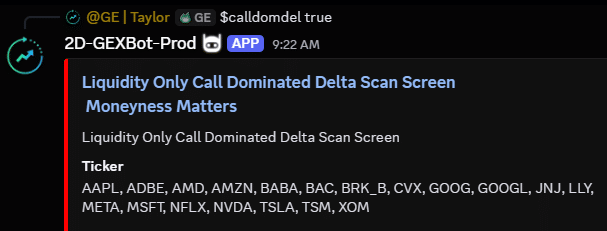
- $ncalldomdel (Newly Call-Dominated Structures): Identifies stocks that have recently shifted to call dominance. These often represent emerging bullish momentum before it becomes obvious in price action.
- $allcalldom (Complete Call Dominance): Filters for stocks showing call dominance across all major Greeks (Delta, Gamma, Charm, Vanna). These represent the strongest structural foundation for call option strategies.
For Put Option Targets (When Market Environment = Bearish)
$putdomdel ( Put-Dominated Structures): Shows stocks where put positioning controls key strikes above and below current price. These stocks have structural support for downward moves.
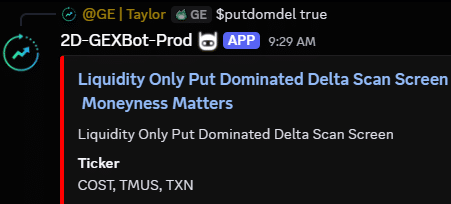
- $nputdomdel (Newly Put-Dominated Structures): Identifies stocks recently transitioning to put dominance. These often signal developing bearish momentum in the early stages.
- $allputdom (Complete Put Dominance): Filters for stocks showing put dominance across all Greeks. These represent the most structurally sound foundations for put option strategies.
Why This Call Options vs Put Options Screening Routine Beats Traditional Stock Screening
- Traditional Approach: Screen thousands of stocks based on technical criteria, fundamental metrics, or momentum indicators. Hope your analysis identifies opportunities before others do.
- GammaEdge Enhancement: Start with stocks where options positioning already supports your directional bias. Your existing analytical skills become laser-focused on the highest-probability candidates.
The Key Advantage: You’re not trying to predict where smart money will go – you’re identifying where it’s already positioned and trading alongside those structural forces.
Real-World Application To Buying Call Options vs Put Options
Bullish Market Environment Example:
- Market environment analysis shows bullish structure
- Your directional bias = Focus on calls only
- Run $calldomdel scan → Results show NVDA, AAPL, MSFT with strong call positioning
- Apply your normal technical/fundamental analysis to these pre-filtered candidates
- Choose the strongest setups from this structurally aligned list
Bearish Market Environment Example:
- Market environment analysis shows bearish structure
- Your directional bias = Focus on puts only
- Run $putdomdel scan → Results show XLE, financials, some tech names with put dominance
- Use your existing bearish analysis methods on these pre-screened candidates
- Select the most compelling breakdown setups with structural support
Integrating Our Call Options vs Put Options System with Your Existing Process
These scans don’t replace your current stock selection methods – they enhance them by providing a structurally intelligent starting point.
- If you’re a technical trader: Run the appropriate scan, then apply your pattern recognition and indicator analysis to the filtered results.
- If you use momentum strategies: Combine scan results with your momentum criteria to find stocks where structural forces can amplify price movements.
Quality Over Quantity
Rather than analyzing hundreds of random stocks, you’re now focusing your analytical skills on perhaps 5-10 candidates where options positioning supports your directional thesis.
This focused approach means:
- Better analysis quality – More time spent on fewer, higher-probability opportunities
- Improved decision-making – Less analysis paralysis from too many conflicting signals
- Higher success rates – Trading alongside structural forces rather than hoping they don’t matter
The scans transform stock selection from a time-consuming search process into a systematic identification of structurally aligned opportunities where your existing analytical skills have the best chance of success.
Step 4 – Validate Your Call Options vs Put Options Entry Timing with Transition Zones
Having the right market environment and structurally aligned stocks is powerful, but timing your entry can make the difference between a winning trade and watching your options lose value while you wait for movement.
This is where transition zones become critical – they show you exactly when to pull the trigger on your options trades.
GammaEdge Method: Structural Level Validation
Transition zones represent the price levels where market control shifts between call and put speculators. Think of them as the market’s natural acceleration points – areas where breaking through triggers structural forces that can amplify your option positions.
For Call Entries (When Market Environment = Bullish)
Your structurally aligned stock must meet this key criteria:
Trading Above PTrans (Positive Transition)
- PTrans represents where call speculators take control of the market structure
- Above this level, dealer hedging naturally supports upward movement
- Below this level, you’re still in the “chop zone” where direction is uncertain
Confirm Upside Targets
- +GEX Level: Where maximum call speculation (as measured by gamma) is concentrated (primary profit target)
- COI Level: Where the most call open interest sits, regardless of timeframe (secondary profit target)
- These levels give you specific, structure-based profit-taking zones
Verify Market Support
- Ensure broader market momentum (from your Market Trend Model analysis) supports your individual stock entry
- Look for confluence between stock-specific breakout and market-wide buying pressure
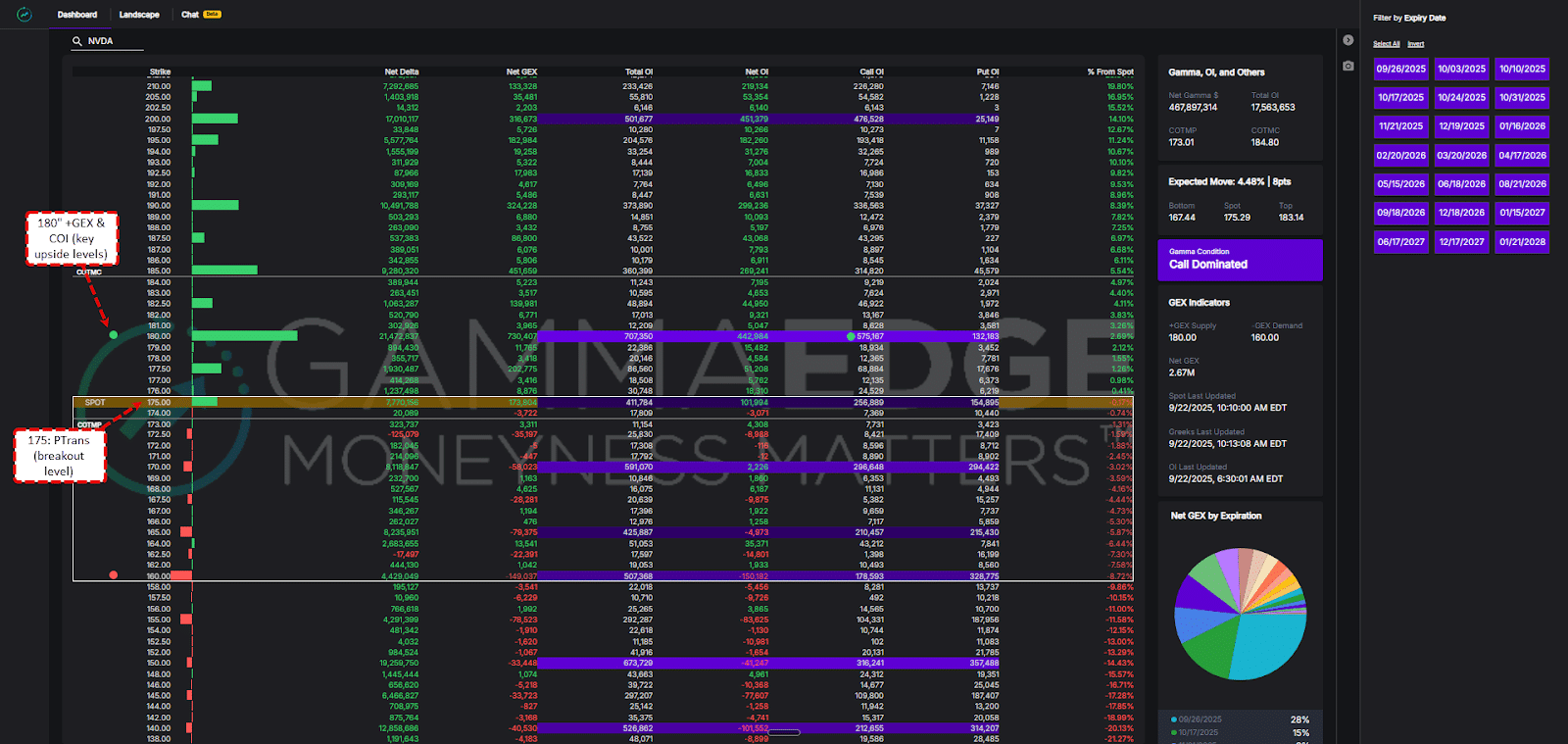
And to help you better understand this concept, let’s walk through an example of $NVDA below (assume the Market Trend Model is showing momentum to the upside). We’ve highlighted the key levels for you:
- 175 being PTrans, which is the level we want to see price break above, which would give us confidence on potential upside higher
- 180 is +GEX and COI, which are the key profit taking levels overhead.
Pro-tip: It’s important to review these levels day over day as they will move as speculators change their positioning. For example, in a bullish environment, we should see +GEX and COI continue to progress higher ahead of spot price as price itself moves higher. This tells us that speculators are continuing to expect further upside.
For Put Entries (When Market Environment = Bearish)
Your put candidates need this structural validation:
Trading Below NTrans (Negative Transition)
- NTrans represents where put speculators gain control of market structure
- Below this level, dealer hedging naturally supports downward movement
- Above this level, you’re in uncertain territory where puts often struggle
Confirm Downside Targets
- -GEX Level: Where maximum put speculation (as measured by gamma) is concentrated (primary profit target)
- POI Level: Where the most put open interest sits regardless of timeframe (secondary profit target)
- These provide objective levels for profit-taking based on actual positioning
Verify Market Support
- Confirm broader market selling pressure supports your individual stock breakdown
- Look for alignment between stock-specific weakness and market-wide distribution
The Confluence Factor: When Multiple Tools Align
The highest-probability entries occur when multiple GammaEdge tools confirm the same directional thesis:
Maximum Confluence Example:
- Market Environment: Bullish (Market Trend Model + SPX structure)
- Stock Selection: NVDA appears on $calldomdel scan
- Structure: NVDA trading above PTrans with clear +GEX target
- Sentiment: GEX Ratio rising, Delta Balance showing call dominance across timeframes
- Timing: Market Trend Model shows institutional buying supporting the move
When this many indicators align, you’re not gambling – you’re systematically positioning when structural forces support explosive option moves.
Avoiding the Transition Zone Trap When Buying Call Options vs Put Options
- Common Mistake: Buying options when stocks are still within their transition zones, hoping for a breakout.
- Why this fails: Within transition zones, market makers have minimal exposure, meaning dealer hedging won’t amplify your moves. You’re essentially trading in a low-conviction area where price can drift randomly.
- GammaEdge Discipline: Wait for clean breaks through transition levels before committing capital. The patience to wait for structural confirmation often makes the difference between winning and losing trades.
Entry Timing Best Practices
For Call Options:
- Stock breaks and holds above PTrans
- Broader market showing buying pressure
- Clear path to +GEX/COI targets visible
- No immediate resistance levels blocking the move
For Put Options:
- Stock breaks and stays below NTrans
- Broader market showing selling pressure
- Clear path to -GEX/POI targets available
- No major support levels interfering with decline
Risk Management Integration:
- Stop Loss: If stock moves back through transition zone, your structural thesis is invalidated
- Profit Targets: Use +GEX/COI (calls) or -GEX/POI (puts) for systematic profit-taking
- Position Sizing: Larger positions when multiple indicators align, smaller when signals are mixed
Why This Systematic Approach To Buying Call Options vs Put Options Works
Traditional options trading often relies on hope: “I think this stock will move, so I’ll buy options and see what happens.”
The GammaEdge framework eliminates guesswork:
- You know the market environment supports your direction
- You’ve identified stocks where positioning aligns with your bias
- You’re entering when structural levels confirm your timing
- You have objective profit targets and stop losses based on market structure
This systematic approach doesn’t guarantee every trade will work, but it dramatically improves your odds by ensuring multiple layers of analysis support your directional thesis before you risk capital.
The Bottom Line: Systematic Direction Decisions
The difference between struggling with options direction and consistently making profitable choices isn’t luck or market timing – it’s having a systematic framework that aligns your trades with the dominant structural forces driving today’s markets.
What we’ve covered today without a doubt got you closer to finding when to buy call options vs put options, and here’s how:
What You’ve Unlocked
The Complete GammaEdge Framework:
- Market Environment Assessment – Use Market Trend Model and SPX structure analysis to determine if conditions favor calls or puts
- Directional Bias Alignment – Focus exclusively on the direction that market structure supports
- Structural Stock Selection – Use proprietary scans to find stocks where options positioning supports your bias
- Transition Zone Validation – Time entries when structural levels confirm your directional thesis
Key Insight: This framework doesn’t replace your existing analytical skills – it enhances them by showing you when and where those skills have the highest probability of success.
Your Next Steps
Start Implementing Today:
- Begin incorporating market environment assessment into your daily routine
- Use GammaEdge scans to filter your watchlist for structurally aligned opportunities
- Practice identifying transition zones before committing capital to directional trades
- Track how your success rate improves when multiple structural factors align
Free Resources to Accelerate Your Learning:
This systematic approach may represent a new way of thinking about markets. That’s exactly why we created our flagship educational course called the GammaEdge FastPass, designed to significantly accelerate your learning curve as it relates to all things options market analysis.
As with all our education, it’s completely free and gives you everything a paid member gets:
- Complete methodologies and frameworks
- Advanced tool tutorials
We hold nothing back. Get your copy of the FastPass here:
Every successful call options vs put options trader started exactly where you are now. The difference between those who consistently profit and those who struggle isn’t talent – it’s having a systematic approach based on understanding how markets actually work.
Stop guessing about options direction. Start trading with the structural analysis that separates winners from the crowd.
The framework is proven. Your job is consistent application and letting market structure guide your directional decisions rather than fighting against forces you can’t see.
The next time you’re staring at your watchlist wondering whether to buy calls or puts, remember: the answer isn’t in the individual stock chart – it’s in the systematic framework that reveals where market structure creates the highest probability of success.